Position:Associate professor
Degree: Doctor
From Fixed Mass to Designable Inertia
Our research develops lightweight, efficient, and verifiable dynamic design methods for structures, equipment, and energy infrastructure. In the past, inertia was primarily determined by how much an object weighed; with inerter-based systems, inertia can also be engineered through how a device is designed and connected.
Original Value | Making inertia a designable engineering resource for structures and equipment
The objective is not only to reduce vibration, but also to redesign inertia, dynamic transmission, and energy utilisation.
| Theoretical Value | An inerter produces a real interaction force between two terminals in response to their relative acceleration. This turns inertia from an attribute tied to physical mass into an independently designable and connectable fundamental dynamic element, extending the classical m–c–k system to an m–c–k–b network. |
| Engineering Value | A strong inertial effect can be obtained without adding an equivalent amount of physical mass. This enhances energy dissipation, improves low-frequency control, and reduces added mass in wind turbine towers, subway environments, liquid-storage tanks, industrial equipment, and existing structures. |
| Beyond Vibration Control | Real inertial force and networked inerter design can also support vibration-energy harvesting and generation, mechanical metamaterials and wave control, vehicle suspensions, robotics, precision equipment, and electromechanical systems. |
Original research pathway: real inertial force → damping enhancement → m–c–k–b coordination → dynamic negative-stiffness coordination → lightweight engineering control
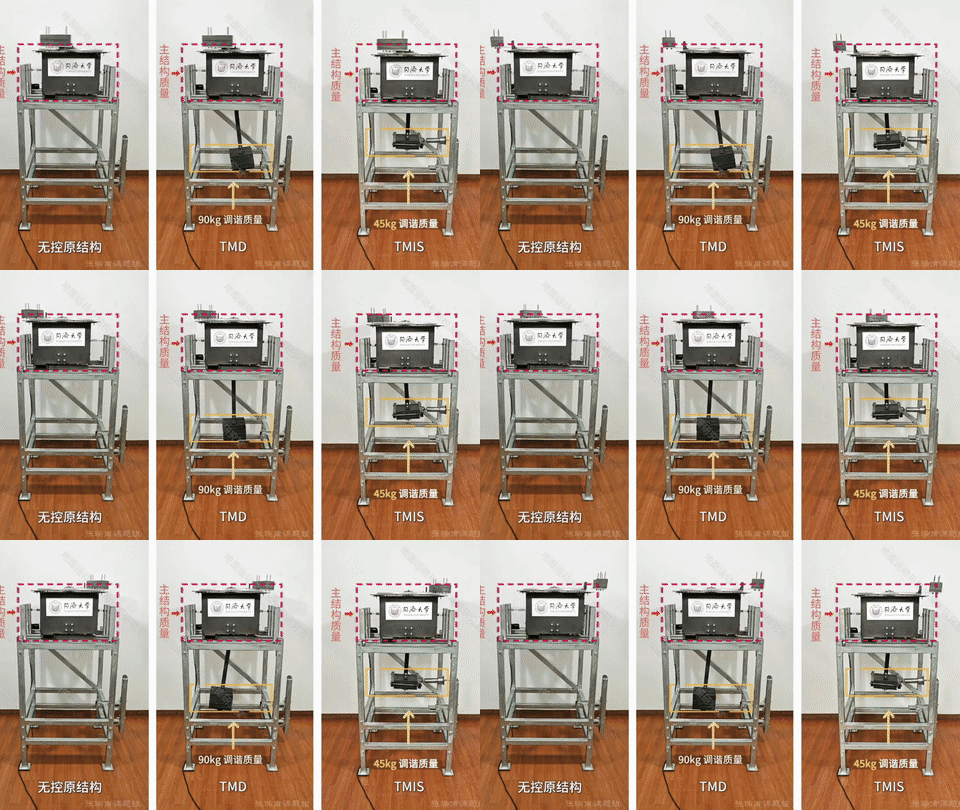
Lightweight tuned vibration control: 45 kg TMIS versus a 90 kg conventional TMD
The animation compares the uncontrolled structure, a 90 kg conventional TMD, and a 45 kg tuned mass inerter system, illustrating the potential of inerter technology to reduce the required tuning mass.
Main Research Directions
Inerter systems and high-performance vibration-control devices: real inertial force, mass replacement by inertance, damping enhancement, m–c–k–b coordination, dynamic negative stiffness, device configurations, and performance-based design.
Seismic isolation, vibration mitigation, and structural control: dynamic-response analysis, control-system design, and experimental validation for complex structures.
Wind energy and urban/subway vibration: monitoring, propagation analysis, prediction, and mitigation for wind turbine towers, subway operation, and urban construction.
Advanced damping materials and vibration-control metamaterials: high-damping materials, composite components, and material–structure integration.
Monitoring, intelligent optimisation, and digital assessment: connecting structures, equipment, monitoring data, and computational models through the Engineering Internet for state identification, parameter optimisation, and performance assessment.
Safety and resilience of energy and critical infrastructure: large liquid-storage tanks, offshore wind towers, industrial equipment, and other complex structures.
| For Students Training spans physical mechanisms, modelling, coding, device development, experiments, data analysis, and engineering verification. |
For Industry The group supports vibration diagnosis, solution design, prototype development, testing, and performance verification under clearly defined operating conditions and deliverables. |
