Position:Associate professor
Degree: Doctor
Representative Research Outcomes and Technology Development
This section highlights representative publications, patents, energy-utilisation demonstrations, software, standards, and engineering tools arising from the group's theoretical and engineering research.
Representative Publications and Patents
The publications, DOIs, and granted patent below trace the development from original theory and design methods to device implementation.
| Year | Representative contribution | Representative publication or patent |
| 2018 | Demand-oriented design of structures with inerter systems | Structural Control and Health Monitoring 10.1002/stc.2051 |
| 2019 | Lightweight tuned parallel inerter mass system for wind turbine towers | Engineering Structures 10.1016/j.engstruct.2018.11.020 |
| 2020 | Damping-enhancement principle of inerter systems | Structural Control and Health Monitoring 10.1002/stc.2523 |
| 2021 | Targeted vibration-control principle | International Journal of Mechanical Sciences 10.1016/j.ijmecsci.2021.106636 |
| 2021 | Ungrounded tuned mass inerter system (TMIS) | Wind and Structures 10.12989/was.2021.32.6.573 |
| 2024 | Real inertial force and the vibration-control design paradigm | Journal of Vibration Engineering 10.16385/j.cnki.issn.1004-4523.2024.11.006 |
| 2025 | Lightweight pendulum tuned mass inerter system | Engineering Structures 10.1016/j.engstruct.2025.120555 |
| Granted invention patents | 30 granted invention patents. Representative patent: A spatial-cam inerter, No. ZL202110259773.1. |
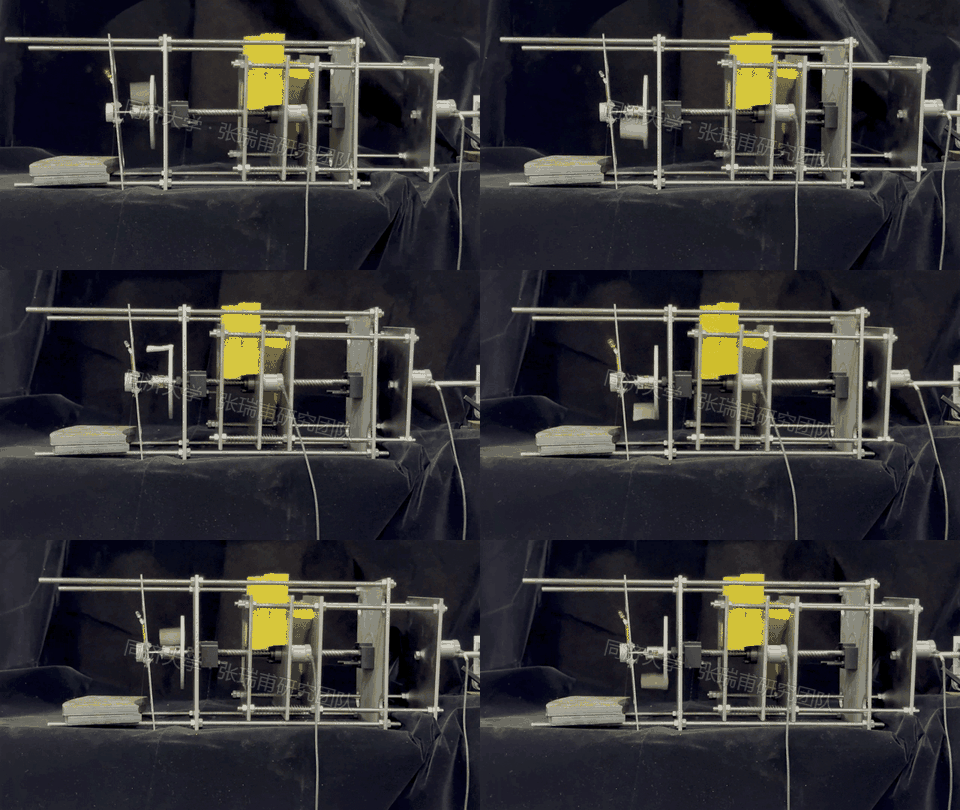
Inerter-Based Energy Generation and Vibration-Energy Utilisation
The group explores vibration-energy capture and electrical conversion based on inerter technology, extending designable inertia beyond vibration mitigation toward self-powered monitoring and low-power sensing.
Software, Standards, and Engineering Tools
The group translates theory and algorithms into reusable engineering tools for structural analysis, parameter optimisation, signal processing, and model conversion. The portfolio also includes seven standards as of March 2026.
INERTER: dynamic analysis of multi-degree-of-freedom structures with inerter systems
EQSignal: earthquake-motion signal processing and analysis
SAP2000–OpenSees structural-model conversion
Parameter optimisation and analysis of impact energy-dissipation inerter systems
Optimisation of inerter systems considering soil–structure interaction
These tools support research computation, scheme comparison, experimental data processing, and engineering performance assessment.
